


Howdy folks, it’s the third week of March 2026, and welcome to This Week in The West.
I’m Seth Spillman, broadcasting from the National Cowboy & Western Heritage Museum in Oklahoma City.
On this podcast, we share stories of the people and events that shaped the history, art and culture of the American West—and those still shaping it today.
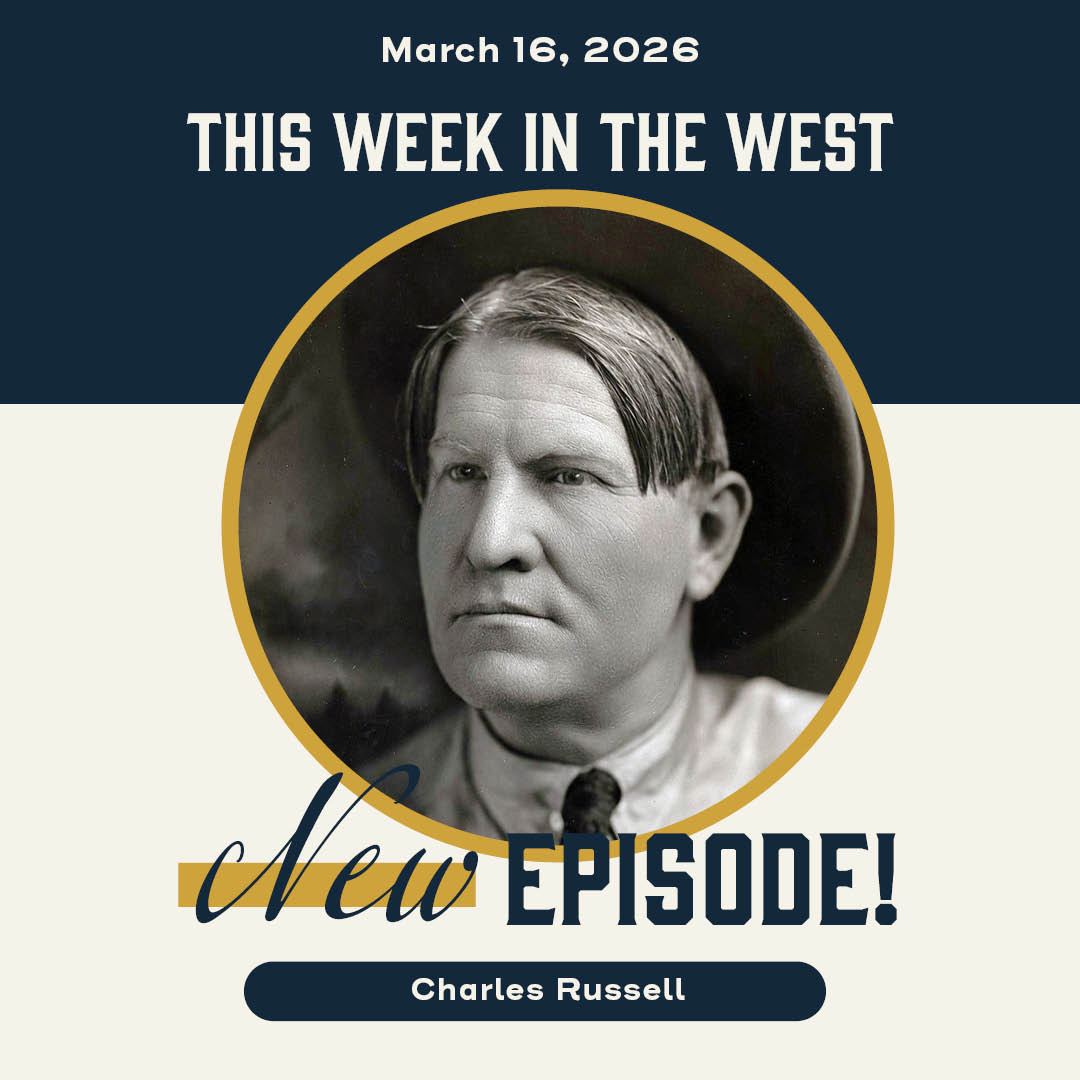
A 16-year-old Charles Marion Russell must have been very persuasive.
Before he was one of the greats of Western Art, Russell was a St. Louis teenager convincing his parents that the time was right for him to pursue his dream of becoming a cowboy and move to Montana.
Somehow, Russell talked them into it. Instead of following the path of prominence and public service like everyone else in the family, Russell was ready to get dirt under his fingernails, mud on his boots and live an authentic life in the West.
Today, we remember Russell, one of the original members of our Hall of Great Westerners, on the Week of his birth, March 19, 1864.
Russell always had a knack for the outdoors and a spirit that pined for adventure.
From an early age, he was far more interested in drawing animals than studying arithmetic. He molded figures from clay, devoured stories of explorers and fur traders and declared by the age of ten that he intended to be a cowboy.
When his family said yes to his move to Montana, they thought one trip would cure him of his fascination with the frontier.
Instead, it anchored him to it for the next 46 years.
When Russell arrived in Montana in 1880, the West was still raw and unsettled. The open range stretched for miles and bison still roamed parts of the plains. Native nations were only a generation removed from their own lands. The railroad was coming, but it had not yet finished remaking the landscape.
In Montana, Russell tried his hand at sheep herding but failed spectacularly. He later joked, that he lost sheep as fast as they were put on the ranch.
But cattle outfits soon gave him work as a night wrangler, the lowest rung on the cowboy ladder and, for Russell, the perfect job.
By day, he observed cowboys at work: roping, branding, riding and resting. By night, he worked. And in every spare moment, he sketched.
For more than a decade, Russell lived the life he would later paint. He worked in central Montana and lived with Jake Hoover, a hunter, trapper and mountain man who became his mentor. Hoover’s respect for the land and friendship with Native people left a deep impression on the young cowboy.
Russell sought out Native communities. He learned sign language, stayed in camps and listened carefully. In 1888, he spent months living with the Blood Indians, part of the Blackfeet Nation.
When painting Native people, Russell distained the stereotype and instead painted them as individuals—hunters, families, warriors and elders—rooted in culture and tradition. Historians still rely on his work to understand clothing, tools and customs that vanished during westward expansion.
During the brutal winter of 1886–87, Russell was working on the O-H Ranch in Montana. He watched as snow, wind and starvation devastated cattle herds.
When the ranch owner wrote asking how the cattle had fared, Russell’s answer was given in art. On a small piece of cardboard, he sketched a gaunt steer standing in the snow while wolves watched from the shadows. Beneath it, he wrote a simple caption: Waiting for a Chinook.
That small painting changed Russell’s life. Passed from hand to hand in Helena, it brought him attention, commissions and the realization that his art could preserve what the West was losing.
In 1893, he set down his saddle and committed fully to art.
Two years later, his life changed again when he met Nancy Cooper. She was young, determined and fiercely protective of his talent. They married in 1896, and she became not just his wife but his business partner, promoter and champion.
Where her husband was generous to a fault—often giving away paintings— Nancy Russell was relentless. She negotiated with galleries, arranged exhibitions across the United States and even in London and insisted on regular work habits. Russell later admitted that without her prodding, much of his work would never have been created.
Together, they built a life in Great Falls, Montana, where Russell became a local celebrity and an international name. His studio was filled with Native clothing, cowboy gear, weapons and artifacts. He used them to make sure every detail of his paintings was accurate.
Unlike artists who emphasized sweeping landscapes alone, Russell focused on people and captured moments. He painted campfire scenes. Working cowboys. Quiet reflection. Sudden violence. He used his art to remember what it felt like to be there.
Russell produced thousands of works, including oil paintings, watercolors, drawings and sculptures. He illustrated letters to friends, designed Christmas cards and signed his correspondence with a buffalo skull, a symbol of what had been lost.
Actors, filmmakers and storytellers became collectors and friends. Will Rogers, William S. Hart and Douglas Fairbanks were among those drawn to Russell not just for his art, but for his warm and witty personality.
Despite international acclaim, Russell never left Montana. He believed he belonged where his stories came from.
“Guard, protect and cherish your land,” he once wrote. “For there is no afterlife for a place that started out as Heaven.”
When he died in 1926, the city of Great Falls paused. Schools released children so they could watch his funeral procession. His coffin traveled through town in a glass-sided coach pulled by four black horses.
In 1955, he was inducted into our first class of Great Westerners, along with notable men like Will Rogers, Theodore Roosevelt and Charles Goodnight. Before we even had a building here at The Cowboy, we had paid tribute to Charles Russell.
Today, our collection includes not only some of his important works but also personal items such as letters, guns, and other artifacts.
And with that, we’ve talked you into listening to another episode of “This Week in the West.”
Our show is produced by Chase Spivey and written by Mike Koehler.
Follow us and rate us on Apple Podcasts or wherever you hear us. That helps us reach more people.
Come visit us in Oklahoma City! You can now buy tickets online thecowboy.org/tickets
Got a question or a suggestion? Drop us an email at podcast@thecowboy.org
We leave you today with the words of Charles Russell biographer John Taliaferro: “Charlie Russell lamented the loss of a West that has passed, but then went on to convince us and convince himself that that West, that mythic West, had been quite real. And the way he was able to convince us really was because he was so authentic himself.”
Much obliged for listening, and remember, come Find Your West at the National Cowboy & Western Heritage Museum.