


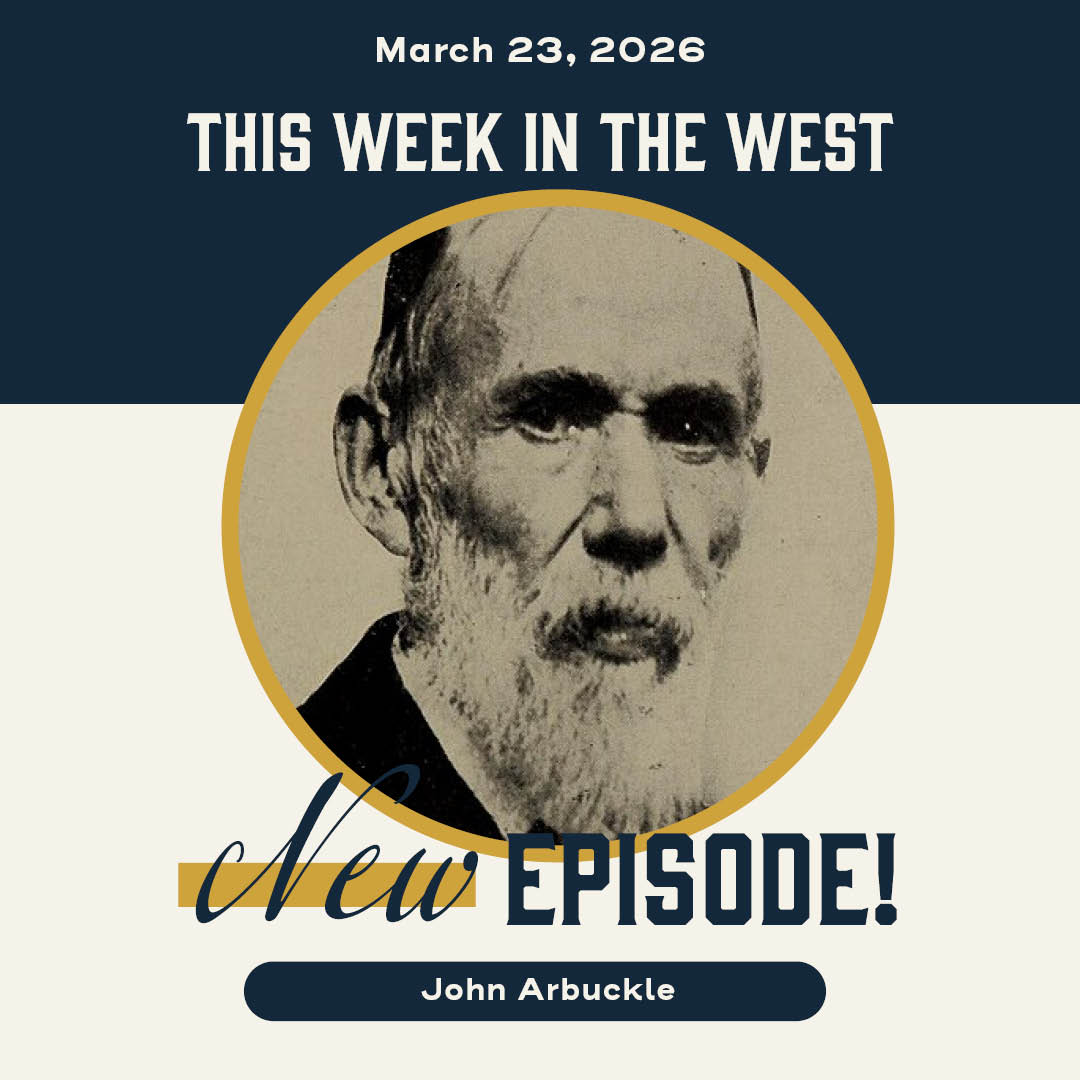
Howdy folks, it’s the fourth week of March 2026, and welcome to This Week in The West.
I’m Seth Spillman, broadcasting from the National Cowboy & Western Heritage Museum in Oklahoma City.
On this podcast, we share stories of the people and events that shaped the history, art and culture of the American West—and those still shaping it today.
Here’s a little peek inside the imagination of us folks here at This Week in the West.
When we picture our faithful listeners, we’re thinking of you enjoying your Monday morning, listening to us and enjoying a hot cup of coffee.
Ah, coffee. As we will find out today, not only does it provide most of us the fuel we need to get through the day, it also powered cowboys in the American West on those chilly mornings decades ago, driving cattle across the plains.
And that’s in large part because of John Arbuckle, who we remember today during the week of his death, March 27, 1912.
Before coffee was just a drive-thru away, it was a fragile commodity. Roasted beans went stale quickly. Most families bought green beans and roasted them in a skillet over the fire at home. One burned bean could ruin the whole batch. Consistency was rare, and freshness was unreliable.
John Arbuckle saw a golden opportunity in that breakfast-time frustration.
Born in 1838 and raised in Pittsburgh, Arbuckle entered the grocery trade with his brother Charles. One product captured his imagination. How could he turn coffee into cash?
In 1868, he patented an egg-and-sugar glaze that coated roasted coffee beans, sealing them from air and extending their shelf life. That one innovation changed everything.
For the first time, Americans could buy roasted coffee in one-pound paper packages that stayed fresh.
His brand, Ariosa, quickly spread across the country. By the 1870s and 1880s, Arbuckle Brothers had moved their operations to New York and operated dozens of industrial roasters. They developed machinery that filled, weighed, sealed and labeled bags in one continuous motion. It was modern food production before most Americans knew what that meant.
But it was not city dwellers alone who made Arbuckle rich.
It was the West.
On the cattle trails, coffee was not a luxury. It was survival.
Long before dawn, before the herd stirred and the wranglers readied the horses, the chuck wagon cook had a pot already boiling. They’d take their three- to five-gallon tin pot and hang it over coals or rest the pot in the embers.
Cowboys drank coffee with breakfast. They drank it before taking night guard. They drank it after four hours in the saddle. They drank it when sleep was impossible, but exhaustion could quickly turn into bad decisions.
Trail boss George Duffield once wrote of men riding through sixty straight hours of storm. What kept them upright? Bread and coffee.
One cook estimated he went through 175 pounds of beans a month. The men, he said, “half lived on coffee.”
They liked it strong, scalding hot and black. No mocha frappuccinos on the cattle drive.
Anything weak was derided as “bellywash” or “brown gargle.” Some chuck wagon cooks never threw out their old grounds, simply adding new ones day after day until the pot could hold no more.
Before Arbuckle, settlers sometimes drank substitutes made from rye, parched corn or bran because good coffee was hard to obtain on the frontier. But Arbuckle’s glazed, packaged Ariosa could travel hundreds of miles by rail and wagon without losing freshness.
Soon, in frontier towns like Dodge City and Tombstone, many cowboys simply called coffee “Arbuckle.” The brand name became generic. If you ordered coffee, you got Arbuckle.
It earned the slogan: “The Coffee that Won the West.”
Each bag of Ariosa included a coupon — worth one cent — redeemable for merchandise. Customers could save enough coupons for aprons, pocket knives, razors, and even a revolver. In some Western communities, the coupons functioned like currency during drought years when cash was scarce.
Cowboys often nicknamed their newest trail hand “Arbuckle” because they could be hired and paid with a handful of coupons.
Even the packaging had value. The 150-pound cloth sacks became dish towels, bandages or aprons. The sturdy Maine fir crates were repurposed into furniture, toolboxes, chicken coops and wagon boxes.
But inevitably, success brought competition. Out West, James A. Folger built his own coffee empire along the Pacific Coast, eventually challenging Arbuckle in Texas. Folger’s advertisements boasted: “No prizes. No coupons. Nothing but satisfaction.”
Back East, Arbuckle expanded into sugar refining, provoking a fierce price war with sugar magnate Henry Havemeyer. The so-called “Sugar War” cost millions and drove prices down dramatically. Coffee quality across the industry suffered as companies cut corners.
Arbuckle weathered the fight, but the strain was real. When he died in 1912, the company began to decline. By the late 1930s, the Arbuckle empire was sold off.
In 1974, Pat and Denney Willis brought the brand back. Arbuckle now operates a 7,000 sq ft. facility deep in the heart of the Old West in historic Tucson, Arizona.
Dive into the history of the West and you can still find stories of how much coffee was a lifeblood of the frontier experience.
Lieutenant William H.C. Whiting once wrote that you give a cowboy some coffee and tobacco, and he could endure any hardship. Julia Brier, one of the first people to cross Death Valley, later said coffee was “a wonderful help,” and without it, she believed she would have died.
When we picture the West or see a painting by Remington or Russell of cowboys around the chuck wagon or a campfire, that battered tin pot with steam rising from it is as much a part of the picture as leather chaps and a ten-gallon hat.
Inside that cup was likely Arbuckle.
We hope your Java hits the spot just as much this morning – or whenever you give us a listen.
And with that, we’ve gotten to the last drop of another episode of “This Week in the West.”
Our show is produced by Chase Spivey and written by Mike Koehler.
Follow us and rate us on Apple Podcasts or wherever you hear us. That helps us reach more people.
Come visit us in Oklahoma City! You can now buy tickets online at thecowboy.org-slash-tickets
Got a question or a suggestion? Drop us an email at podcast@thecowboy.org
We leave you today with a poem by legendary Cowboy poet S. Omar Barker, on what makes for truly good Cowboy coffee:
“Now here is the recipe, time-tried and true,
For chuck wagon coffee, the buckaroo’s brew:
Use Arbuckles Roasted, in case you can get it,
Pour in enough water to just sort of wet it,
Boil hard for an hour, then into it toss,
The well-rusted shoe off a club-footed hoss;
Gaze into the pot for a few minutes steady—
If the hoss shoe is floatin,’ your coffee is ready!”
Much obliged for listening, and remember, come Find Your West at the National Cowboy & Western Heritage Museum.
We leave you today with the words of Charles Russell biographer John Taliaferro: “Charlie Russell lamented the loss of a West that has passed, but then went on to convince us and convince himself that that West, that mythic West, had been quite real. And the way he was able to convince us really was because he was so authentic himself.”
Much obliged for listening, and remember, come Find Your West at the National Cowboy & Western Heritage Museum.