

Howdy folks, it’s the second week of April 2026, and welcome to This Week in The West.
I’m Seth Spillman, broadcasting from the National Cowboy & Western Heritage Museum in Oklahoma City.
On this podcast, we share stories of the people and events that shaped the history, art and culture of the American West—and those still shaping it today.
On the east side of our building here at The Cowboy, catty-corner to a looming sculpture of Abraham Lincoln, is another statue.
Ronald Reagan stands tall, holding a cowboy hat in his right hand, casually dressed in a jacket and jeans. His left hand is open, just enough to tempt people to shake it.
Two things to remember.
First, please don’t touch the statues here at The Cowboy, pardner, no matter how much you admire the former president.
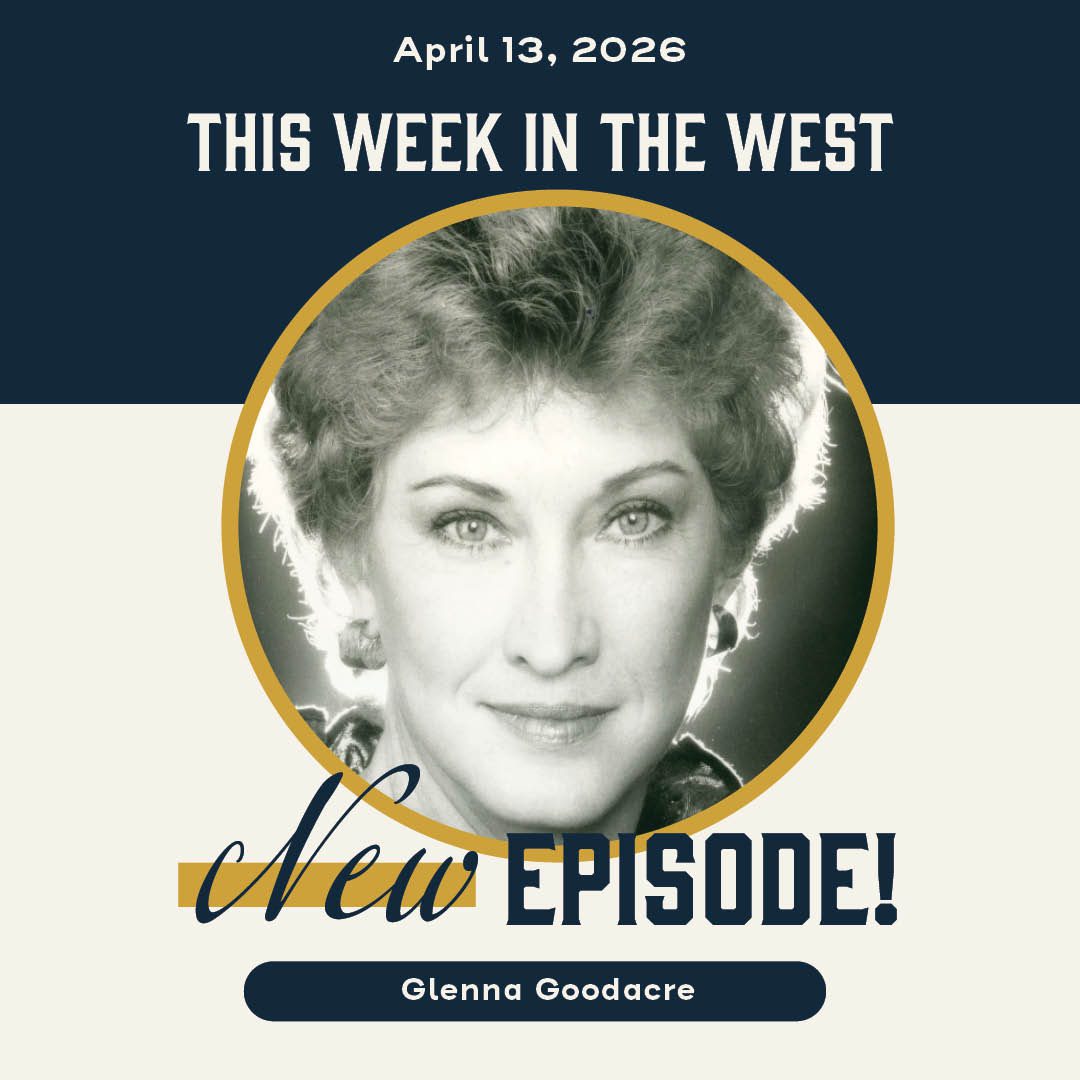
And second, take a moment to remember its creator, one of the greats of modern Western sculpture: Glenna Goodacre.
Today, we tell her story on the week of her death, April 13, 2020.
Goodacre’s striking bronze statue of President Ronald Reagan is titled After the Ride. It’s a piece that captures Goodacre’s ability to combine history, personality and storytelling in a single moment frozen in time.
But the story of Glenna Goodacre’s career stretches far beyond one statue.
In fact, her work can be found across the United States — in museums, public parks, national memorials and even in the change in your pocket.
Glenna Maxey Goodacre was born August 28, 1939, in Lubbock, Texas. Her family was well known in the region. Her father, Homer Glen Maxey, was a builder and civic leader who served on the Lubbock City Council and was deeply involved in the growing West Texas community.
She attended Monterey High School in Lubbock before continuing her education at Colorado College, and later studied at the prestigious Art Students League in New York City.
Those experiences exposed her to both classical sculpture traditions and contemporary artistic ideas.
But it was the American West that became her deepest source of inspiration.
In 1983, she moved to Santa Fe, New Mexico, a city long known as a gathering place for artists drawn to the region’s landscapes, cultures and stories.
There, Goodacre built a studio and began producing the work that would eventually make her one of the most respected sculptors in the country.
Over a career spanning more than 50 years, Glenna Goodacre created more than 600 sculptures.
Her work is known for its expressive faces, textured surfaces and lifelike figures. One of her most famous works stands on the National Mall in Washington, D.C.
In 1993, the Vietnam Women’s Memorial was installed near the Vietnam Veterans Memorial.
Goodacre’s sculpture depicts three military nurses caring for a wounded soldier — a powerful tribute to the thousands of women who served in Vietnam. Her goal was to portray compassion and strength in equal measure.
Said Goodacre: “There will always be a place for commemorative sculpture because it is three-dimensional, people can walk up, identify, congregate, photograph, touch, be in the historical moment. Certainly, there are wonderful historic paintings, but you can’t put a painting in the park.”
Another monumental work, the Irish Memorial in Philadelphia, includes 35 life-size bronze figures and tells the story of Irish immigration during the Great Potato Famine.
Asked about the work, Goodacre said the deep meaning of the figures made them hard to finish, saying, “You never know when to stop on a figure. I want people to look at the emotion in a face.”
“I wanted to make a piece that people will stop and study and remember, [to] learn about this starvation.”
It remains one of the largest and most ambitious public sculptures in the United States.
But one of her smallest works may be the one people are most familiar with.
In 1999, the United States Mint selected her design for the Sacagawea dollar coin.
Her portrait of the Shoshone woman Sacagawea — carrying her infant son on her back — began circulating in 2000 and remains one of the most recognizable modern coin designs in the country.
“While over the years most coin designs have had their share of critics, not so with the Sacagawea dollar. Everyone loves it,” wrote the coin-collecting magazine Numismatic News.
Her statue of Reagan, located both here at The Cowboy and at the Presidential Library in California, remains one of Goodacre’s most lauded works.
The sculpture shows Reagan relaxed but confident, as if he has just stepped down from a horse after a ride across the ranch.
That detail is important.
Reagan wasn’t just a president — he was also deeply tied to Western identity and the cowboy spirit.
A member of both our Hall of Great Westerners and Hall of Great Western Performers, the former Hollywood actor-turned-politician was known for his Western films, embracing the cowboy ethos of independence and optimism.
Instead of portraying Reagan in a formal political pose, Goodacre presents him in a moment that reflects his connection to the American West.
The piece stands seven and a half feet tall, and its relaxed stance and subtle expression lend it a striking sense of personality that draws in guests.
Goodacre’s achievements brought her recognition across the art world.
Her work earned major honors, including the James Earl Fraser Sculpture Award at the Prix de West Exhibition here at the museum in 2002 for her work “Crossing the Prairie.”
She also received the Texas Medal of Arts, was named a Notable New Mexican, and was inducted into the National Cowgirl Museum and Hall of Fame.
Back in her hometown, the city of Lubbock even named a downtown street Glenna Goodacre Boulevard in her honor.
In 2016, after decades of work, Goodacre announced her retirement from sculpting.
In a symbolic gesture, she destroyed the molds used to cast many of her works. She donated tools, materials, and sculptures to the New Mexico School for the Arts, helping to support the next generation of artists.
Glenna Goodacre passed away on April 13, 2020, at the age of 80.
And with that, we’ve flipped the coin on another episode of “This Week in the West.”
Our show is produced by Chase Spivey and written by Mike Koehler.
Follow us and rate us on Apple Podcasts or wherever you hear us. That helps us reach more people.
Come visit us in Oklahoma City! You can now buy tickets online at thecowboy.org-slash-tickets
Got a question or a suggestion? Drop us an email at podcast@thecowboy.org
We leave you today with the words of Glenna Goodacre: “I am a very positive person, so most of my work tends to be upbeat, if not downright happy. I don’t do morosely philosophical pieces like some artists. It’s just not in me.”
Much obliged for listening, and remember, come Find Your West at the National Cowboy & Western Heritage Museum.