



Howdy folks, it’s the third week of April 2026, and welcome to This Week in The West.
I’m Seth Spillman, broadcasting from the National Cowboy & Western Heritage Museum in Oklahoma City.
On this podcast, we share stories of the people and events that shaped the history, art and culture of the American West—and those still shaping it today.
It was 1867, and John Muir’s future looked like it was set out for him. Continue working at the Osgood, Smith & Co. carriage factory, and he might become a partner in the business.
He was hard at work at the factory one day, tightening a belt on a machine, when he lost his grip on the metal awl he was holding. It flew up, hit him in the eye and punctured his cornea.
“My right eye is gone,” workers in the shop heard him cry out. He’d lost his sight, and soon after, his uninjured left eye temporarily sank into “sympathetic” blindness.
Muir’s life had been radically changed, and when he recovered, he decided to literally walk a different path, one that would lead him to the West and the life of the country’s first great naturalist.
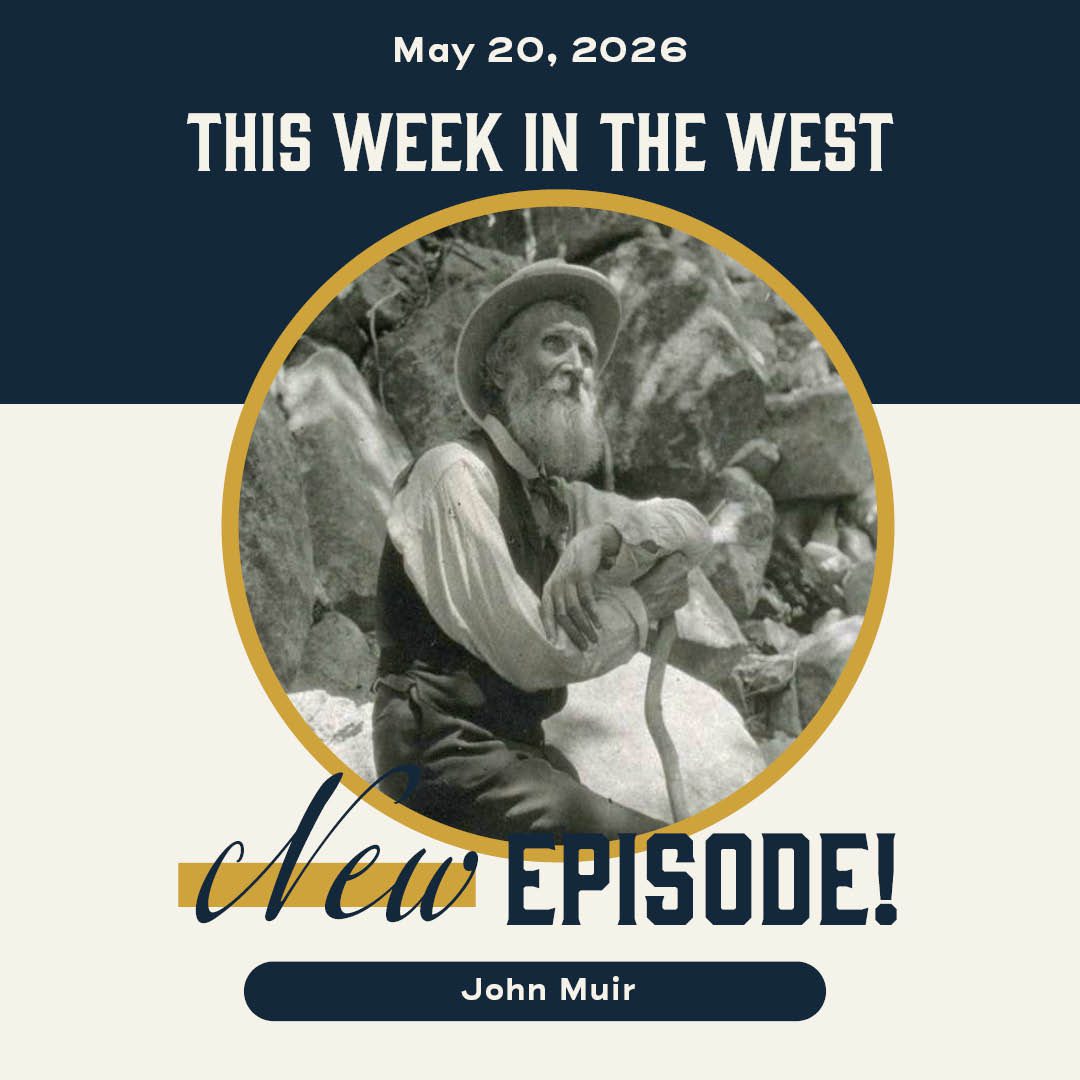
Today, we remember the life and impact of Muir, who was born this week, April 21, 1838.
Muir was born in Dunbar, Scotland. When he was eleven years old, his family immigrated to the United States and settled on a farm in Wisconsin. His father was deeply religious and harshly disciplined the family, expecting constant work and Bible study.
The labor was hard, and the rules were strict, so young Muir sought solace in the only place he could, the woods and fields surrounding the farm.
He watched birds, studied plants and developed a habit that would define his life: paying close attention. He was also mechanically gifted. As a young man, he built clocks, tools and clever inventions by hand, earning admiration at the Wisconsin State Fair and later attending the University of Wisconsin.
After college, Muir went to work at the factory in Indianapolis. After the accident, he didn’t know when his sight would return. But when it did, he felt he had been given a second chance.
He decided to no longer be cooped up, surrounded by machines; he would instead dedicate himself to the outdoors.
So he set out on foot.
Muir walked roughly a thousand miles from the Midwest to the Gulf of Mexico, following what he called the “wildest, leafiest and least trodden way” he could find.
He studied plants, slept outdoors and absorbed any lessons he could glean from the outdoors. After an illness interrupted his journey, he sailed to Cuba and eventually made his way west to California.
In 1868, Muir reached San Francisco and almost immediately headed for Yosemite. He had read about it, but nothing prepared him for the reality.
When he entered the Sierra Nevada and saw the granite cliffs, waterfalls, meadows and forests of Yosemite, he felt transformed.
Later, he would call the Sierra the “Range of Light,” and for the rest of his life, those mountains would be his spiritual home.
He worked odd jobs to survive — shepherd, mill worker, guide — but his real work was observing, climbing, writing and learning.
He lived for a time in a small cabin along Yosemite Creek, where he arranged for water to flow through part of the cabin so he could hear the stream inside his home. In the mountains, he traced plant life through elevation zones and became convinced that glaciers had shaped Yosemite Valley.
At the time, that theory ran counter to accepted scientific opinion. But Muir trusted what he saw in the field, and eventually his observations helped change geology’s understanding of the valley.
He wrote prolifically about the nature of the West, but never strayed too far from scientific observation. He could describe a mountain sunrise in language full of reverence and joy, but he also measured glaciers, cataloged plants and tracked the weather.
He wanted people not just to admire nature, but to understand it. His books, essays and articles invited readers into the wilderness with him. And through that writing, he became one of the most influential voices in the history of American conservation.
By the late nineteenth century, the West was changing rapidly. Forests were being cut. Meadows were overgrazed. Sheep and cattle were damaging fragile mountain ecosystems. Muir saw what was happening in the Sierra and knew that beauty alone would not save these places. Somebody had to fight for them.
He began publishing articles calling attention to the damage being done in Yosemite and the surrounding high country. With help from editor Robert Underwood Johnson, Muir pushed the idea that Yosemite should be protected as a national park.
In 1890, Congress passed legislation creating Yosemite National Park.
In 1892, Muir helped found the Sierra Club, an organization dedicated to protecting wild places. He served as its president until his death. He also played an important role in preserving California’s giant sequoias. He influenced the broader movement that would lead to the protection of places like Mount Rainier and the Grand Canyon.
His growing influence eventually reached the White House. In 1903, President Theodore Roosevelt traveled to Yosemite and camped with Muir beneath an open sky.
The two men talked deep into the night about wilderness, public land and the nation’s responsibility to protect its natural inheritance. Roosevelt left that trip deeply impressed, and the encounter helped shape the conservation efforts of his presidency.
After their time together, Roosevelt said: “There can be nothing in the world more beautiful than the Yosemite, the groves of the giant sequoias…our people should see to it that they are preserved for their children and their Children’s children forever, with their majestic beauty all unmarred.”
That meeting became one of the most famous campfire conversations in American history.
But it wasn’t always a pastoral fairy tale life for Muir. He clashed with other leaders over whether nature should be preserved for its own sake or managed for human use. Muir believed some places should remain wild, forbidden from being affected by encroaching settlement.
That belief drove him into the bitter fight over Hetch Hetchy Valley in Yosemite National Park. San Francisco wanted to dam the valley to store water. Muir fiercely opposed it, seeing the valley as every bit as sacred and beautiful as Yosemite itself. Despite years of resistance, the dam was approved in 1913. It was the greatest defeat of his public life. He was heartbroken.
John Muir died the following year, in 1914.
His legacy would live on in hundreds of articles and numerous books and in the enduring grandeur of America’s National Parks System.
In 2006, Muir was inducted into our Hall of Great Westerners.
And with that, we’ve climbed the mountain of another episode of “This Week in the West.”
Our show is produced by Chase Spivey and written by Mike Koehler.
Follow us and rate us on Apple Podcasts or wherever you hear us. That helps us reach more people.
Come visit us in Oklahoma City! You can now buy tickets online at thecowboy.org/tickets
Got a question or a suggestion? Drop us an email at podcast@thecowboy.org
We leave you today with the words of John Muir: “It’s always sunrise somewhere; the dew is never all dried at once; a shower is forever falling; vapor is ever rising. Eternal sunrise, eternal sunset, eternal dawn and gloaming, on sea and continents and islands, each in its turn, as the round earth rolls.”
Much obliged for listening, and remember, come Find Your West at the National Cowboy & Western Heritage Museum.