

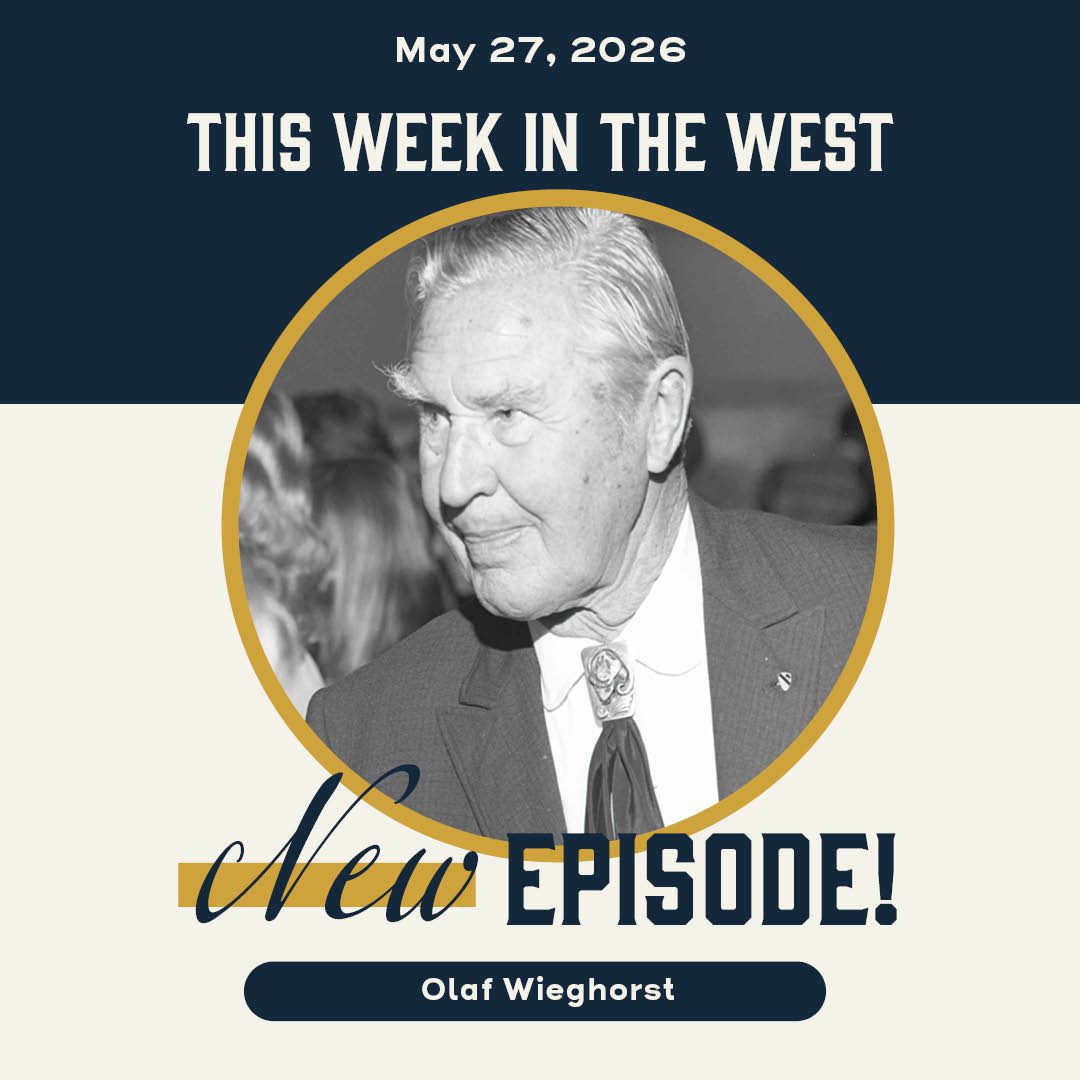
Howdy folks, it’s the last week of April 2026, and welcome to This Week in The West.
I’m Seth Spillman, broadcasting from the National Cowboy & Western Heritage Museum in Oklahoma City.
On this podcast, we share stories of the people and events that shaped the history, art and culture of the American West—and those still shaping it today.
His life reads almost like a Western novel.
He rode horses in a circus.
He jumped ship in New York with just a dollar in his pocket.
He served in the United States Cavalry on the Mexican border.
He worked as a cowboy, a mounted police officer, and eventually became one of the most respected painters of the American West.
His name was Olaf Wieghorst.
And while many artists painted the West from imagination, Wieghorst painted it from experience.
We remember Wieghorst on the week of his birth in Viborg, Denmark: April 30, 1899.
His father worked as a display artist and photo retoucher, while his mother took in sewing to help support the family. Wieghorst grew up surrounded by creativity, but what fascinated him most were horses.
He rode them as a child and studied their strength, movement and personalities. Riding was just one of the physical skills Wieghorst showed early.
By the time he was nine years old, he was already performing acrobatics in the Tivoli Theater in Copenhagen, billed as “Little Olaf – The Miniature Acrobat.” Not long after, he became a bareback rider in the Schumann Circus.
Life on horseback drove Wieghorst’s interest in the American West — he read stories of cowboys, wide open land, and freedom. Like many young people around the world at the time, he imagined America as a place where adventure and opportunity were waiting.
So in 1918, at the age of nineteen, he took a job as a cabin boy on a steamship bound for New York. On December 31st, he jumped ship, arriving in America with just $1.25 in his pocket and only three English words in his vocabulary: “yes,” “no,” and “sure.”
At the time, one of the fastest ways for an immigrant to gain citizenship was to join the U.S. Army.
So Wieghorst enlisted — with one request.
Send him west.
The Army assigned him to the 5th U.S. Cavalry along the Mexican border during the years following the Mexican Revolution. This was the era when the U.S. military still relied heavily on horses, and Wieghorst’s lifelong experience with riding made him a natural fit.
He cared for cavalry horses, rode patrols across the desert and experienced firsthand the life he had once only imagined.
Years later, he would say that when the cavalry stopped using horses, “they took the soul out of that great branch of the service.”
Those years in the Southwest left a permanent impression on him.
After leaving the cavalry in 1922, Wieghorst stayed in the West for a time, working as a ranch hand and cowboy in Arizona and New Mexico. Wherever he went, he sketched what he saw — cowboys around campfires, horses on the open range, riders crossing desert landscapes.
Eventually, he returned to New York, where another chapter of his life began.
In 1924, he married Mabel Walter, a Brooklyn woman who had helped teach him English when he first arrived in America.
That same year, he joined the New York City Police Department. Because of his experience with horses, he was assigned to the Mounted Division, where he trained and broke horses for the department and patrolled Central Park on horseback.
Even while working as a police officer, Wieghorst never stopped drawing. He quietly began selling his artwork during the 1930s.
Since police officers weren’t supposed to run outside businesses, he worked through friends and intermediaries to sell drawings and etchings at rodeos and exhibitions.
His Western scenes began appearing in magazines like Hoofs and Horns and Zane Grey’s Western Magazine.
In 1944, Wieghorst retired from the police department after twenty years of service and headed West for good.
The family settled in El Cajon, California, just east of San Diego. There, Wieghorst built a studio filled with Western artifacts, saddles and memorabilia. He kept horses nearby — both for riding and as models.
Horses became the defining subject of his art. Among the famous horses he painted were Champion, Gene Autry’s horse, and Trigger, the legendary horse of Roy Rogers.
Wieghorst was no stranger to the life of the Hollywood cowboys. In fact, Wieghorst himself appeared briefly in two John Wayne movies in the 1960s: McLintock! and El Dorado.
His paintings often depicted quiet moments of Western life — cowboys resting after a long ride, Native riders crossing desert landscapes, stagecoaches on dusty trails, or solitary riders traveling through wide open country.
Over time, Wieghorst became one of the most respected painters of Western subjects in America. His work was often compared to that of Frederic Remington and Charles Russell, two giants of Western art.
In 1974, we hosted a retrospective of his work here at The Cowboy. In 1970, a book about his career and paintings was honored with one of our Western Heritage Awards. Before his death, the Los Angeles Times called him “America’s highest-paid living artist.”
Olaf Wieghorst passed away in April of 1988 at the age of eighty-eight.
In 1992, he was posthumously inducted into the museum’s Hall of Great Westerners.
And with that, we’ve jumped ship on another episode of “This Week in the West.”
Our show is produced by Chase Spivey and written by Mike Koehler.
Follow us and rate us on Apple Podcasts or wherever you hear us. That helps us reach more people.
Come visit us in Oklahoma City! You can now buy tickets online at thecowboy.org/tickets
Got a question or a suggestion? Drop us an email at podcast@thecowboy.org
We leave you today with the words of Olaf Wieghorst: “I couldn’t have learned what I did from some teacher in art school. I learned about horses by sleeping, freezing, thirsting and starving with them. I learned by doing; I paint what I know.”
Much obliged for listening, and remember, come Find Your West at the National Cowboy & Western Heritage Museum. online at thecowboy.org/tickets
Got a question or a suggestion? Drop us an email at podcast@thecowboy.org
We leave you today with the words of John Muir: “It’s always sunrise somewhere; the dew is never all dried at once; a shower is forever falling; vapor is ever rising. Eternal sunrise, eternal sunset, eternal dawn and gloaming, on sea and continents and islands, each in its turn, as the round earth rolls.”
Much obliged for listening, and remember, come Find Your West at the National Cowboy & Western Heritage Museum.