

Howdy folks, it’s the first week of May 2026, and welcome to This Week in The West.
I’m Seth Spillman, broadcasting from the National Cowboy & Western Heritage Museum in Oklahoma City.
On this podcast, we share stories of the people and events that shaped the history, art and culture of the American West—and those still shaping it today.
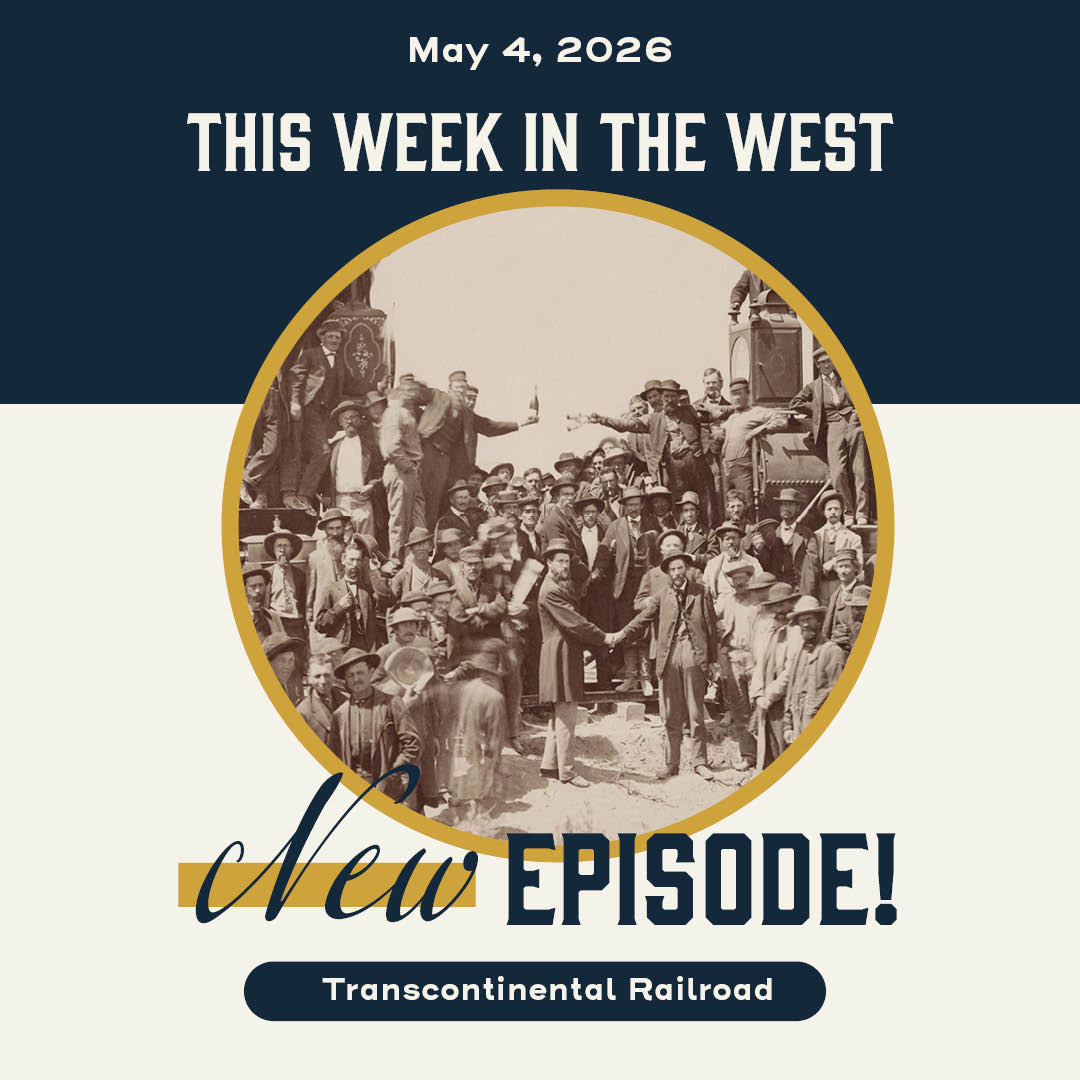
They stood in a crowd, looking forward at the camera. One held a bottle of champagne aloft, some tipped their hats, others puffed out their chests, and the two men in the center shook hands.
It was a photo opp unlike any before it, held in the middle of a remote, wind-swept spot in the Utah Territory called Promontory Summit.
The occasion? The meeting of two locomotives—one from the Central Pacific Railroad and one from the Union Pacific—which faced each other nose to nose on May 10, 1869.
A ceremonial golden spike was tapped into place, completing something that had once seemed impossible: a railroad stretching from the Atlantic coast to the Pacific Ocean.
Today, we remember the anniversary of the historic completion of the transcontinental railroad.
The idea of a transcontinental railroad had been discussed for decades. As the United States expanded westward in the early 19th century, the need for faster, safer travel became increasingly urgent.
There were wagon trains and stagecoaches, but those could take months to cross the country, facing dangers from harsh weather, disease and difficult terrain.
The California Gold Rush of 1849 intensified the pressure. Those eager to make their fortune had few options to get to the West Coast, including an arduous journey by sea around Cape Horn at the tip of South America.
Author Stephen Ambrose, in his book “Nothing Like It in the World,” about the building of the transcontinental railroad wrote: ““A man whose birthday was in 1829 or earlier had been born into a world in which President Andrew Jackson traveled no faster than Julius Caesar, a world in which no thought or information could be transmitted any faster than in Alexander the Great’s time.”
It wasn’t until it was thrown into the Civil War that the federal government took decisive action. In 1862, President Abraham Lincoln signed the Pacific Railway Act, authorizing the construction of the railroad and providing land grants and government bonds to support the effort.
Two companies were tasked with the job. The Union Pacific would build westward from Omaha, Nebraska. The Central Pacific would build eastward from Sacramento, California.
It would not be easy. Bisecting any proposed route were mountains, Native territories and every challenge Mother Nature could throw at the project.
The Central Pacific faced the towering Sierra Nevada mountains almost immediately. Crews, many of them Chinese immigrants, blasted tunnels through solid granite using black powder and, later, nitroglycerin. They worked in brutal conditions, hanging in baskets over cliffs, enduring avalanches and freezing temperatures.
Despite discrimination and dangerous working conditions, Chinese laborers became the backbone of the Central Pacific’s workforce, laying miles of track across some of the most difficult terrain on the continent.
Meanwhile, the Union Pacific pushed west across the Great Plains. Its workforce included Irish immigrants, Civil War veterans and formerly enslaved men. The daily grind on the workforce was an equal opportunity ordeal.
There was extreme heat, bitter cold and the constant pressure to build quickly. The plains offered fewer natural obstacles than the mountains, but the work was no less demanding.
Construction cut through territories long inhabited by Native American tribes, disrupting migration patterns and threatening traditional ways of life. The expansion of railroads accelerated settlement, trade and industry, but it also intensified conflict and displacement across the West.
The rise of the railroad also brought hunters who nearly wiped out the American Bison on the Plains.
By 1869, after years of relentless labor, the two lines finally met at Promontory Summit. The golden spike ceremony was symbolic to be sure, but telegraph wires carried news of the final blow across the country in real time, and celebrations erupted in cities from San Francisco to New York.
The impact of the transcontinental railroad was immediate and far-reaching. What once took months could now be accomplished in about a week. Goods moved faster. People traveled more easily. Markets expanded, and the American economy grew at an unprecedented pace.
Wrote Stephen Ambrose: “Time, along with work, is a major theme in the building of the railroad. Before the locomotive, time hardly mattered. With the coming of the railroad, time became so important that popular phrases included “Time was,” or “Time is wasting,” or “Time’s up,” or “The train is leaving the station.” What is called “standard time” came about because of the railroads. Before that, localities set their own time. Because the railroads published schedules, the country was divided into four time zones.”
Once that golden spike – inscribed with the words “May God continue the unity of our Country as this Railroad unites the two great Oceans of the world.”- was driven in the ground, the country changed forever.
Towns sprang up along the rail lines, many of them becoming lasting communities that still exist today.
The railroad helped shape the very map of the American West, determining where people settled and how industries developed. It also played a role in the rise of iconic Western experiences: cattle drives, boomtowns and the growth of cities like Denver and Cheyenne.
At the National Cowboy & Western Heritage Museum, the story of the railroad intersects with many of the themes we explore every day.
The expansion of rail lines influenced the cattle industry, allowing ranchers to ship livestock to markets in the East, thanks to the efforts of cowboys and drovers.
Artists, too, captured the transformation. Painters like Albert Bierstadt documented the vast landscapes of the West at a time when they were being rapidly altered by technology and settlement. His works, including those featured here at the Museum, remind us of the scale and beauty of the land that the railroad helped to open—and transform.
Lincoln would never see the completion of the Transcontinental Railroad, but he foretold his views on the project, saying: “There is nothing more important before the nation than the building of the railroad to the Pacific.”
And with that, we’ve pulled into the station on another episode of “This Week in the West.”
Our show is produced by Chase Spivey and written by Mike Koehler.
Follow us and rate us on Apple Podcasts or wherever you hear us. That helps us reach more people.
Come visit us in Oklahoma City! You can now buy tickets online at thecowboy.org-slash-tickets
Got a question or a suggestion? Drop us an email at podcast@thecowboy.org
We leave you today with the words of poet Walt Whitman.
“I see over my own continent the Pacific Railroad, surmounting every barrier,
I see continual trains of cars winding along the Platte, carrying freight and passengers,
I hear the locomotives rushing and roaring, and the shrill steam-whistle,
I hear the echoes reverberate through the grandest scenery in the world.”
Much obliged for listening, and remember, come Find Your West at the National Cowboy & Western Heritage Museum.