





Howdy folks, it’s the fourth week of November 2025, and welcome to This Week in The West.
I’m Seth Spillman, broadcasting from the National Cowboy & Western Heritage Museum in Oklahoma City.
On this podcast, we share stories of the people and events that shaped the history, art and culture of the American West—and those still shaping it today.
Maybe all Joseph Glidden wanted to do was make his wife happy.
It was 1873 on a farm a mile west of DeKalb, Illinois and Lucinda Glidden was tired of the cows leaving the pasture and getting into her yard. She urged her husband, Joseph, to solve the problem.
Inspiration struck Joseph when he saw a bowl of wire hairpins sitting in a milk-glass dish on Lucinda’s dresser. He fiddled and experimented with wire, trying to shape something with a pair of pliers. He took the problem to his friend, a blacksmith, and finally made a breakthrough.
It may have been Lucinda’s problem, but she wasn’t the only one.
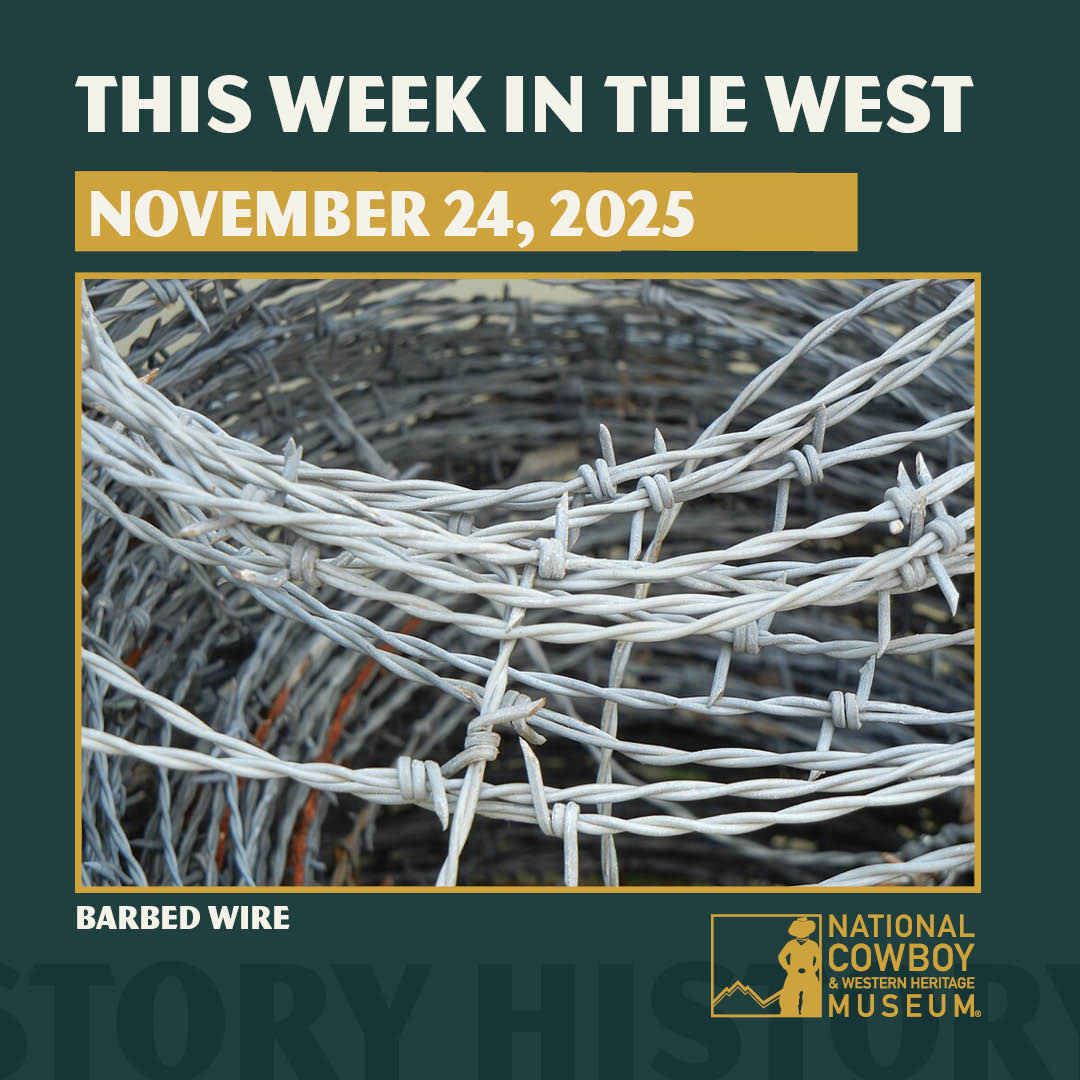
Because this week, on November 24, 1874, Joseph Glidden became the official inventor of modern barbed wire. He patented “The Winner,” a new type of barbed wire that would become the most popular in the country and transform the West.
Now, here are a few caveats to keep us from being pulled into any “origins of barbed wire” drama.
Before settling on his design, Glidden had seen the work of Henry B. Rose, who had patented “The Wooden Strip with Metallic Points” in May 1873 at a county fair. Other inventors, like Isaac L. Ellwood and Jacob Haish, had competing popular designs. Haish and Glidden would fight it out in the courts, with Glidden eventually winning when their case made it to the Supreme Court.
Between 1868 and 1874, barbed wire variations received more than 500 patents. The quote “fencing problem” was a hot debate around the country. As settlement grew, thanks in part to the Homestead Act, so did disputes over land use. Fencing was at the heart of the growing conflict between farmers and ranchers. Farmers wanted ranches fenced. Ranchers wanted farms fenced. Animal branding had developed to tell one person’s herd from another, but then came Glidden.
So what made Glidden’s Patent 1-5-7-1-2-4 the magic number?
It was cheap, effective and easy to make.
Fencing before barbed wire was either labor-intensive or difficult on the treeless prairie. Glidden’s breakthrough made the vast plains a patchwork of claimed parcels.
But that containment meant much “wild” in the Wild West. Cattle trails, which generally could have grazed on the open range, would be increasingly restricted.
In his book “Cowboy Life in Texas,” W.S. James relayed the lament of a cowboy who saw the barbed wire revolution taking place.
“When I saw the barbed-wire machine at work manufacturing it and was told that there were thousands of them at the same work, I went home and told the boys they might as well put up their cutters and quit splitting rails and use barbed wire instead,” the Cowboy said. “I was as confident then as I am today that wire would win … and that between barbed wire and the railroads, the cowboys’ days were numbered.”
For his part, Glidden didn’t spend long in the barbed wire business. By 1876, he sold half of the manufacturing company, opting to retain a royalty for any wire sold. This decision made Glidden a wealthy man. The rate was said to have been 25 cents per one hundred pounds of barbed wire sold. By the time Glidden’s famous patent expired in 1892, the royalties had made him one million dollars.
But barbed wire had its dark side.
Barbed wire would also restrict the movement of the American Bison, contributing to its decline in population. It would be used to draw the boundaries of the prisons and reservations that the government used against Native Americans.
Into the 20th Century, barbed wire became a deadly element of World War I and a symbol of the concentration camps of World War II.
Glidden died on October 9, 1906, at age 93.
Following his death, one newspaper obituary was blunt in assessing his legacy.
“Joseph F. Glidden, who invented the barbed wire fence, is dead,” Wrote the Duluth, Minnesota News-Tribute. “Unfortunately, his invention survives and possesses a most distressing, clothes-tearing, hide-rendering activity.”
And with that, we’ve unspooled another episode of “This Week in the West.”
Our show is produced by Chase Spivey and written by Mike Koehler.
Follow us and rate us on Apple Podcasts or wherever you hear us. That helps us reach more people.
You can follow us on social media and online at nationalcowboymuseum.org.
Got a question or a suggestion? Drop us an email at podcast@thecowboy.org
We leave you today with the words of John “Bet-a-Million” Gates, a famous barbed-wire salesman from Texas, talking about his product: “This is the finest fence in the world. It’s light as air, stronger than whiskey and cheaper than dirt.”
Much obliged for listening, and remember, come Find Your West at the National Cowboy & Western Heritage Museum.